

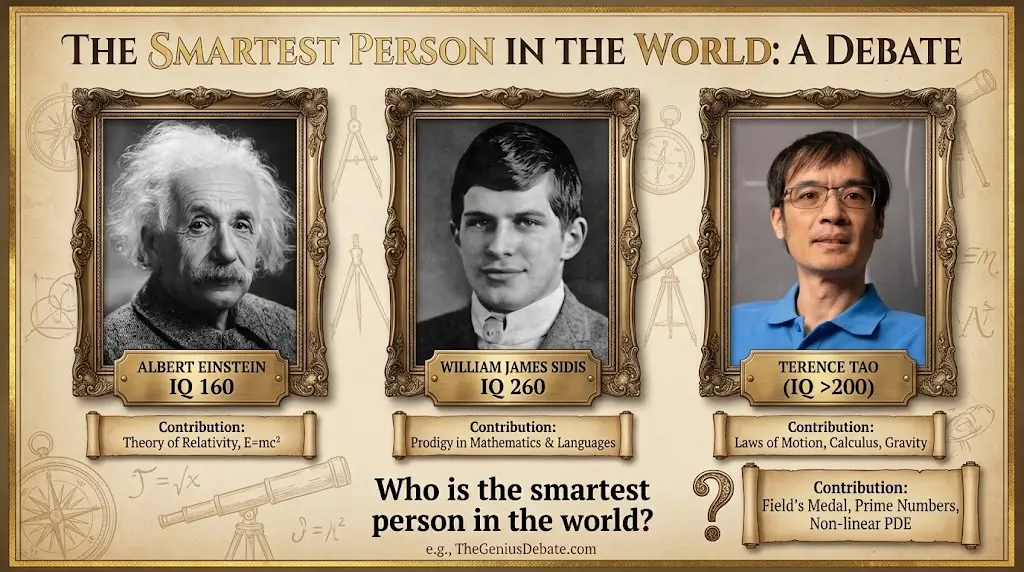
Who is the smartest person in the world? If you want the short answer for 2026, most experts point to Terence Tao, the Australian-American mathematician with a reported IQ of 225–230 and a Fields Medal to back it up. The full answer is more complicated, though. Intelligence has many forms, IQ tests have limits, and history is full of geniuses who never sat a single test. I have spent years checking IQ claims against verified achievements. In this guide I sort the documented facts from the newspaper myths and cover the smartest people alive today, the greatest minds in history, and what the scores actually mean.
Biography Table
| Field | Details |
|---|---|
| Full Name | Terence Chi-Shen Tao |
| Nickname | “The Mozart of Maths” |
| Date of Birth | 17 July 1975 |
| Place of Birth | Adelaide, South Australia |
| Age | 51 (as of 2026) |
| Nationality | Australian-American |
| Zodiac Sign | Cancer |
| Ethnicity | Chinese heritage |
| Profession/Occupation | Mathematician, UCLA Professor |
| Years Active | 1996–present |
| Education | BSc (1991) and MSc (1992), Flinders University; PhD, Princeton University (1996) |
| Genre/Field | Harmonic analysis, PDEs, additive combinatorics, number theory |
| Spouse/Partner | Laura Tao |
| Children | 2 |
| Parents | Billy Tao and Grace Tao |
| Siblings | Trevor Tao, Nigel Tao |
| Notable Works | Green–Tao theorem on prime numbers, 300+ research papers |
| Awards/Honors | Fields Medal (2006), MacArthur Fellowship (2006), Breakthrough Prize in Mathematics (2015, $3M) |
Who Is The Smartest Person In The World Right Now?
The smartest person in the world right now, judged by verified achievement, is Terence Tao. His reported IQ of 225–230 matters less than his record. He has published more than 300 papers, worked with over 100 co-authors, and made major contributions to several separate branches of mathematics.
Tao’s childhood was remarkable. He was doing college-level math at around 9. At 10 he became the youngest medal winner at the International Mathematical Olympiad, and he took IMO gold in 1988 at just 13, which is still a record. He finished his bachelor’s at 16, his master’s a year later, and his Princeton PhD at 20.
In 2000, at age 24, UCLA made him a full professor, the youngest in the university’s history. His 2004 work with Ben Green proved that prime numbers contain arbitrarily long arithmetic progressions, and that result helped earn him the 2006 Fields Medal, the highest honor in mathematics.
Tao often gets the title of smartest person in the world today because few other living minds combine three things: a credible high IQ, peer-judged work, and range across fields. Some people claim higher scores but have little published work. Many brilliant researchers excel in only one narrow area. Tao is unusual in having all three.
Not every expert would crown him alone. Physicists such as Edward Witten have equally strong claims within their own disciplines. In my experience, Tao comes up most often because his achievements are easy to verify and hard to dispute, and that makes him the safest answer to who is the smartest person in the world in 2026.
What Does “Smart” Really Mean?
Being smart means being able to learn quickly, solve new problems, and apply knowledge in situations you have not seen before. Dictionaries treat “clever,” “intelligent,” and “smart” as close synonyms, but psychologists separate raw reasoning ability from accumulated general knowledge.
This difference explains why a high IQ does not guarantee accomplishment. Christopher Langan, often called the smartest man in America with an estimated IQ of 195–210, has spent much of his life outside academia. Other people with average scores create work that changes the world. Intelligence is potential. What a person does with it is a separate question.
Psychologist Howard Gardner argued that intelligence comes in several distinct types rather than one single score:
- Linguistic-verbal: skill with words, writing, and languages
- Logical-mathematical: reasoning, patterns, and abstract math
- Visual-spatial: picturing objects, maps, and designs in the mind
- Musical: sensitivity to rhythm, pitch, and composition
- Naturalistic: recognizing patterns in nature and living things
- Interpersonal and intrapersonal: understanding others and yourself, closely linked to emotional intelligence (EQ)
When I evaluate claims about intelligent people, I use one practical rule: the criteria should match the field. A polymath like Leonardo da Vinci shows spatial and creative brilliance, while a mathematician shows logic. Ranking them on a single scale ignores what made each of them exceptional.
How Is IQ Measured And What Do The Scores Mean?
IQ, or Intelligence Quotient, is a standardized score that compares a person’s reasoning, memory, and problem-solving against a norm group, with 100 set as the average. In 1904–1905, Alfred Binet in France created the first practical test to identify students who needed extra help in school.
German psychologist William Stern introduced the IQ concept as a ratio of mental age to real age. Lewis Terman at Stanford refined Binet’s work into the Stanford-Binet test, which became the US standard in the early 20th century. Later, the WAIS (Wechsler Adult Intelligence Scale) became the most widely used adult test.
Terman’s classification remains the best-known way to read scores:
| IQ Range | Classification |
|---|---|
| 140+ | Genius or near genius |
| 120–139 | Gifted / very superior |
| 110–119 | Above average |
| 90–109 | Average |
| 80–89 | Below average |
| 70–79 | Borderline |
| Below 70 | Substandard (intellectual disability range) |
About two-thirds of people score between 85 and 115. That means anyone scoring 140+ is rare, and claims above 200 sit far beyond what most standard IQ tests can reliably measure.
IQ testing has always been controversial. Critics point to cultural, linguistic, and economic bias, since a test written for one population can disadvantage another. Children who grow up in poverty or with limited schooling often score lower for reasons unrelated to ability, which is why careful psychologists treat IQ as one data point, not a final verdict.
The Highest IQ Ever Recorded
The highest IQ ever officially recorded belongs to Marilyn vos Savant, whose score of 228 was listed by Guinness World Records from 1986 to 1989. That figure came from a Stanford-Binet test she took at age 10 in 1956, and it was calculated using the old mental-age formula.
Born in Missouri in 1946, vos Savant became famous through her “Ask Marilyn” column in Parade magazine. In 1990 she answered the Monty Hall problem correctly by advising the reader to switch doors, and thousands of letters, many from people with PhDs, insisted she was wrong. Mathematicians later confirmed she was right. She later married Robert Jarvik, designer of an early artificial heart.
Guinness retired the “Highest IQ” category in 1990 because scores at such extreme levels cannot be measured reliably. Ratio IQs given to children can inflate dramatically, and modern deviation-based tests rarely go beyond about 160. Every score above that range deserves caution.
More recent claims show why. In April 2024, South Korea’s YoungHoon Kim publicized a claimed IQ of 276, but no recognized norm group or standard test confirms it. Whenever I review public claims like this, I ask three questions: which test, on what date, under what conditions? Most 250–300 figures fail at least one of them.
What About The Lowest IQ Possible?
There is no meaningful “lowest IQ ever” record. Most standard tests have a floor around 40–50, below which the scale stops working. Psychologists use other assessments at that level, so headlines claiming a “lowest record” usually reflect a misunderstanding of how the scale works.
Why There Is No Single “Smartest Person”
No one can be named the smartest person in history with complete certainty, because there is no comparable IQ score for most geniuses. Newton, Gauss, and Euler never took a test, and the estimates attached to them are educated guesses based on their published work.
Fields also resist comparison. How do you weigh Shakespeare’s literature against Einstein’s physics, or Beethoven’s music against Gauss’s mathematics? Victorian polymath Sir Francis Galton showed that crowds can estimate some things well, but even large polls of respondents mostly reflect personal preferences and national pride.
In the 2000s, memory expert Tony Buzan and chess grandmaster Raymond Keene published a ranking of history’s top geniuses. They placed several names, including Michelangelo, Thomas Jefferson, Alexander the Great, the sculptor Phidias, and the Egyptian pyramid architects, at equal ratings. That approach is a quiet admission that genius rarely fits a strict leaderboard.
The strongest claim anyone can make is narrower: who produced the most fundamental, peer-judged work in a given field? That question has defensible answers, and it is the framework I use for the lists below.
Smartest People Alive Today
The people below are the names most often linked with the question of who is the smartest person in the world today. I have grouped them by the type of evidence behind their reputation.
Christopher Hirata
Christopher Hirata, born in Michigan in 1982, has the second-highest IQ figure commonly reported among living people, at 225. At 13 he won gold at the International Physics Olympiad, and he was taking college courses at 14.
He entered Caltech at 14 and earned his BS in 2001. At 16 he reportedly worked with NASA on research related to Mars colonization. He then completed his PhD at Princeton in 2005 and focused on cosmology.
Hirata’s research covers dark energy, gravitational lensing, galaxy clustering, and the cosmic microwave background. He now works at Ohio State’s Center for Cosmology and AstroParticle Physics (CCAPP) and has helped plan major space telescopes. Despite his reputation, he keeps a notably low public profile.
Christopher Langan
Christopher Langan, born in San Francisco in 1952, became known as the “smartest man in America” after a 1999 ABC 20/20 segment. Neuropsychologist Robert Novelly estimated his IQ at 195–210, among the highest he had measured.
Langan’s life story is unusual. He grew up in poverty, taught himself advanced math, physics, philosophy, Latin, and Greek, and earned a perfect SAT score. He left Reed College and Montana State, and later worked as a construction worker, cowboy, and long-time nightclub bouncer.
His main intellectual project is the Cognitive-Theoretic Model of the Universe (CTMU), which he presents as linking mind, reality, and God. Academic professors have largely ignored it, and his controversial statements, including about 9/11, have damaged his reputation. He now lives on a horse ranch in Missouri. His case shows clearly that a high IQ does not guarantee recognized achievement.
Grigori Perelman
Grigori Perelman, born in St Petersburg in 1966, solved the Poincaré conjecture, one of the seven Millennium Prize Problems. He published his proof as online preprints in 2002–03 rather than in a formal journal, and mathematicians spent years confirming it.
He then did something almost unheard of. He declined the 2006 Fields Medal and turned down the Clay Institute’s $1 million prize in 2010, saying his contribution was no greater than that of others. He left mathematics and reportedly lives a simple, secluded life with his mother.
To me, Perelman is one of the purest examples of intellect without ego. There is no public IQ score for him, yet his single proof outweighs most leaderboard claims.
Edward Witten
Edward Witten, born in Baltimore in 1951, is widely considered the greatest living theoretical physicist. Unusually, his first degree was in history from Brandeis in 1971 before he turned to physics and earned a Princeton PhD in 1976.
He is the only physicist ever to win the Fields Medal, in 1990. His 1995 proposal of M-theory unified five competing versions of string theory and reshaped the field. He has also received the Dirac Prize and Einstein Medal and appeared on the TIME 100 list.
Witten works at the Institute for Advanced Study in Princeton, once Einstein’s home. Colleagues often describe him as the architect of modern string theory, making him one of the strongest candidates for the smartest person in the world right now.
Kim Ung-Yong
Kim Ung-Yong of South Korea was once listed by Guinness with an IQ of 210. As a toddler he reportedly read in several languages, and by age 4 he was solving calculus problems on television.
At around 8 he went to the US, where he studied and was linked to NASA research until 1978. He later said those years were lonely. He returned to Korea, earned a PhD in civil engineering, and became a professor at Shinhan University.
The press once called him a “failed genius” for choosing an ordinary academic career. He rejected that label, saying happiness mattered more than fame. His story is one I often cite when people assume a high IQ must lead to world-changing work.
Chess Minds: Carlsen, Kasparov And Polgár
Chess is one of the few fields where intellect is ranked objectively through ratings. Magnus Carlsen, born in Tønsberg, Norway, in 1990, became a grandmaster at 13, became world #1 at 19 in 2010, and was world champion from 2013 to 2023. His peak rating of 2882 is the highest in history.
Garry Kasparov, born in Baku in 1963, was world champion from 1985 to 2000 and number one for two decades. He beat IBM’s Deep Blue 4–2 in 1996 but lost to an upgraded version in 1997. He retired in 2005. IQ figures attributed to him vary widely and none come from an official, published test.
Judit Polgár of Budapest, born in 1976, became a grandmaster at 15 in 1991 and broke Bobby Fischer’s record. She is the only woman ever to reach the overall world top 10. She has beaten several current or former world champions, including Kasparov and Karpov. Her father raised her as an experiment to prove that geniuses are made, not born.
Other Living High-IQ Names
These names often appear on lists of the smartest people in the world by IQ. Most scores are self-reported or estimated, so treat them as claims rather than verified facts.
| Name | Born | Reported IQ | Known For |
|---|---|---|---|
| Evangelos Katsioulis | 1976, Greece | ~198 | Psychiatrist, founder of World Intelligence Network |
| Rick Rosner | 1960, US | ~192 | TV writer for Jimmy Kimmel Live, Emmy nominee |
| Mislav Predavec | 1967, Croatia | ~190 | Math professor, founder of GenerIQ society |
| John H. Sununu | 1939, Cuba | ~180 | Former White House Chief of Staff, Mega Society member |
| James Woods | 1947, US | ~180 | Actor, MIT student, two Oscar nominations |
| Ruth Lawrence | 1971, UK | ~175 | Oxford math degree at 13, knot theory |
| Manahel Thabet | Yemen | ~168 | Financial engineering PhD, UN humanitarian award |
| Adhara Pérez Sánchez | Mexico | ~162 | Two degrees before her teens, STEM ambassador |
Smartest People In History
When people ask who was the smartest person in the world historically, these names appear most often. None took a modern IQ test, so all scores are retroactive estimates.
Sir Isaac Newton (1642–1726)
Isaac Newton is the most common answer to who was the smartest person ever, with estimates of 190–200. In his 1687 Principia he set out the three laws of motion and universal gravitation, and those laws formed classical mechanics for over 300 years.
He developed calculus independently of Leibniz and built the first practical reflecting telescope. His prism experiments, published in Opticks in 1704, showed that white light contains the full color spectrum.
Newton also had a lesser-known side. He spent years on alchemy and theology and even predicted the world might end after 2060. As Master of the Mint, he personally pursued counterfeiters, and his work led to the hanging of William Chaloner. Few people match his range.
Albert Einstein (1879–1955)
Albert Einstein’s IQ is usually estimated at around 160, though he never took an IQ test and the figure rests on weak evidence. The German-born physicist was born on 14 March 1879 and died on 18 April 1955.
His special relativity introduced time dilation and mass-energy equivalence, E=mc². His general relativity redefined gravity as the curvature of spacetime. He won the 1921 Physics Nobel for explaining the photoelectric effect, a foundation of quantum theory.
His ideas now power GPS, semiconductors, nuclear energy, and medical imaging. Einstein himself credited imagination over knowledge, and he loved music and philosophy. In my view, his true gift was questioning established norms that everyone else accepted.
Leonardo Da Vinci (1452–1519)
Leonardo da Vinci, with estimated IQs of 180–220, is history’s defining Renaissance man. He painted the Mona Lisa and The Last Supper and also worked as a sculptor, architect, engineer, and anatomist.
His surviving notebooks contain thousands of pages of sketches. They include designs for flying machines, a helicopter-like device, a parachute, a diving suit, a tank, and even a mechanical robot, centuries before the technology existed.
His anatomy drawings remained the most accurate for generations, and his notes on optics, geology, hydrodynamics, and botany show a mind that saw no wall between art and science. For visual-spatial intelligence, no one in history has a stronger case.
William James Sidis (1898–1944)
William James Sidis holds the highest IQ estimate in history, 250–300, though it is unverified. Born in Boston on 1 April 1898 to Ukrainian Jewish immigrants Boris and Sarah Sidis, he entered Harvard at 11. In 1910 he lectured the Harvard Math Club on four-dimensional bodies.
He graduated cum laude at 16 in 1914 and briefly taught at Rice Institute. In 1919 he was arrested at a May Day march and sentenced to 18 months. He reportedly knew dozens of languages, invented one of his own, and wrote The Animate and the Inanimate (1925) on cosmology.
Press attention exhausted him. He took menial jobs, wrote under pseudonyms, and lost a landmark privacy case after a mocking 1937 New Yorker article. He died of a stroke at 46 in 1944. Biographer Amy Wallace and many psychologists treat him as the classic case of a prodigy harmed by fame.
Nikola Tesla (1856–1943)
Nikola Tesla, born on 10 July 1856 in present-day Croatia, is credited with modern AC electricity. Estimates of his IQ range widely, from about 160 to 310, which shows how loose these figures can be.
After a brief job with Edison, Tesla developed the AC induction motor, polyphase distribution, the transformer system, and the Tesla coil. Westinghouse used his system to light the 1893 World’s Fair and to power the Niagara Falls power plant.
He held hundreds of patents and pioneered radio-control, X-ray experiments, and wireless energy at Wardenclyffe. Today’s drones, robotics, and smartphones trace ideas back to him. Yet he died almost penniless in New York in 1943.
Johann Wolfgang Von Goethe (1749–1832)
Goethe received the highest score, about 210, in psychologist Catherine Cox’s famous 1926 study of historical geniuses. Germany’s greatest writer, he produced The Sorrows of Young Werther, Wilhelm Meister, and his masterpiece, Faust.
He was also a statesman in Weimar, a leader of the Sturm und Drang and Weimar Classicism movements alongside Schiller and Herder, and a serious scientist. His 1810 Theory of Colours challenged Newton, and he made genuine discoveries in botany and anatomy.
Marie Curie (1867–1934)
Marie Curie, estimated at 180–200, was the first woman to win a Nobel Prize. She is still the only person to win Nobels in two different sciences: Physics in 1903 (shared) and Chemistry in 1911.
Born in Poland, she discovered polonium, named after her homeland, and radium, and she pioneered the study of radioactivity. During WWI she directed the Red Cross Radiological Service and brought mobile X-ray units to the front lines.
Other Historical Geniuses At A Glance
| Name | Era | Estimated IQ | Key Contribution |
|---|---|---|---|
| Aristotle | 384–322 BC | 180–190 | Logic, biology, politics; tutor of Alexander the Great |
| Plato | 427–347 BC | 180–190 | The Republic, founded the Academy |
| Socrates | ~470–399 BC | — | Socratic method, father of Western philosophy |
| Hypatia | ~350/370–415 | 170–210 | Early female mathematician, astrolabe work |
| Avicenna (Ibn Sina) | 980–1037 | — | The Canon of Medicine, Islamic Golden Age |
| Galileo Galilei | 1564–1642 | 180–200 | Improved telescope, defended heliocentrism |
| William Shakespeare | 1564–1616 | ~210 | ~39 plays, 154 sonnets |
| Gottfried Leibniz | 1646–1716 | 182–205 | Calculus, logic, metaphysics |
| Voltaire | 1694–1778 | 190–200 | Candide, Enlightenment philosophy |
| Carl Friedrich Gauss | 1777–1855 | — | Number theory, Disquisitiones Arithmeticae |
| James Clerk Maxwell | 1831–1879 | — | Unified electricity, magnetism, and light |
| Srinivasa Ramanujan | 1887–1920 | ~185 | Infinite series, partition function |
| John von Neumann | 1903–1957 | ~190 | Game theory, modern computer architecture |
| Stephen Hawking | 1942–2018 | ~160 | Hawking radiation, A Brief History of Time |
Child Prodigies And Record Claims
Some of the highest numbers in IQ history come from children, which is a key reason experts treat them carefully. A child’s ratio IQ compares mental age with actual age, so a 6-year-old performing like a teenager can produce an enormous score.
Michael Kearney is the best example. He finished high school at 6 and earned an anthropology degree at 10 in 1994, which made him the youngest graduate on record. Reports of a 325 IQ circulate widely, but no standardized adult test can produce such a score.
Edith Stern, born in 1952, was raised by her father as a deliberate experiment and reportedly scored above 200. She entered college at 12 and later worked at IBM. Other names on prodigy lists include Sho Yano, Jacob Barnett, and Ainan Cawley, and historical estimates exist for figures like John Stuart Mill, Blaise Pascal, and Ada Lovelace.
From what I have seen across these stories, early brilliance is no guarantee of adult impact. Some former prodigies became leading academics, while others, like Sidis, struggled under pressure. Support and emotional well-being seem to matter as much as raw ability.
Living Achievers Ranked By Prizes, Not IQ
If you judge intelligence by verified achievement instead of IQ tests, the answer to who is the smartest person in the world in 2025 and 2026 widens considerably. These living figures have earned the highest honors in their fields:
| Name | Major Honor | Known For |
|---|---|---|
| Geoffrey Hinton | 2024 Physics Nobel, 2018 Turing Award | Foundations of deep learning |
| Demis Hassabis | 2024 Chemistry Nobel | AlphaFold protein structure prediction |
| David Baker | 2024 Chemistry Nobel | Computational protein design |
| Katalin Karikó | 2023 Medicine Nobel | mRNA vaccine technology |
| Jennifer Doudna | 2020 Chemistry Nobel | CRISPR gene editing |
| Roger Penrose | 2020 Physics Nobel | Black hole formation |
| Maryna Viazovska | 2022 Fields Medal | Sphere packing in 8 and 24 dimensions |
| Manjul Bhargava | 2014 Fields Medal | Number theory |
| Avi Wigderson | 2021 Abel Prize, 2023 Turing Award | Computational complexity, zero-knowledge proofs |
| Yoshua Bengio | 2018 Turing Award | Deep learning; among the most cited computer scientists |
| Tim Berners-Lee | 2016 Turing Award | Invented the World Wide Web |
| Shafi Goldwasser | 2012 Turing Award | Cryptography, zero-knowledge proofs |
| Judea Pearl | 2011 Turing Award | Causal inference |
| Barbara Liskov | 2008 Turing Award | Programming languages and systems |
Mathematicians Andrew Wiles and Akshay Venkatesh belong in this group too. Wiles proved Fermat’s Last Theorem after it stood for 358 years and won the 2016 Abel Prize. Venkatesh won medals at both the Physics and Math Olympiads before 13 and earned the 2018 Fields Medal.
Thinkers such as Noam Chomsky, the father of modern linguistics, Donald Knuth, author of The Art of Computer Programming, and Harvard’s Steven Pinker round out the list. I find this prize-based view more useful than IQ leaderboards because every entry is backed by work that others can check.
Can You Raise Your IQ?
Yes, you can improve your IQ score to a modest degree, usually by a few points, and you can strengthen the cognitive skills the tests measure. Your underlying potential is largely stable in adulthood, but your performance responds to habits and practice.
The approaches with the most support are simple:
- Read widely and regularly to build vocabulary and general knowledge.
- Learn a new language or instrument, which trains memory and attention.
- Solve puzzles and logic problems, including chess and math challenges.
- Get full, consistent sleep, since tired brains score noticeably lower.
- Exercise and eat a healthy diet to support blood flow and focus.
- Practice meditation or yoga to improve concentration under pressure.
Be careful with commercial brain games. They often improve your score on that specific game without transferring to wider reasoning. Taking practice IQ tests also inflates results through familiarity, so a higher number may mean you have learned the format rather than grown smarter.
Intelligence matters because it drives innovation, medical breakthroughs, and better solutions to global challenges. In my experience, the habits above improve real-world problem-solving far more than they move a test score, and that is where intelligence counts most.
Frequently Asked Questions
Has the answer changed between 2025 and 2026?
Not significantly. In both 2025 and 2026, Terence Tao remained the most cited answer, with Edward Witten and Christopher Hirata close behind. The main shift is that AI researchers like Hinton and Hassabis now appear more often in achievement-based rankings after their Nobel wins.
Which country has the highest IQ?
National average IQ studies usually place East Asian countries at the top, including Japan, South Korea, Singapore, Hong Kong, and Taiwan. These rankings are debated, because education access, test familiarity, and sampling methods strongly affect national averages.
Who has a 325 IQ?
Michael Kearney is often said to have an IQ of 325, based on testing in early childhood. The figure is not credible on a modern scale, since standard tests like the Stanford-Binet and WAIS cannot measure anywhere near that high.
Is an IQ of 160 considered genius?
Yes. An IQ of 160 falls well inside the 140+ genius range and is reached by roughly 1 in 30,000 people. It is also the score most often attributed to Einstein and Hawking, although neither had an officially published result.
Is there a highest possible IQ?
In theory, there is no fixed maximum. In practice, every test has a ceiling, often around 160 for modern adult tests. Scores reported above that come from ratio formulas, specialized high-range tests, or estimates, so they cannot be compared reliably.
What are the traits of highly intelligent people?
Highly intelligent people tend to show intense curiosity, strong memory, quick pattern recognition, and comfort with complex problems. Many also show creativity and emotional intelligence, and they are often willing to admit what they do not know.
Read About : patrick mahomes contract