

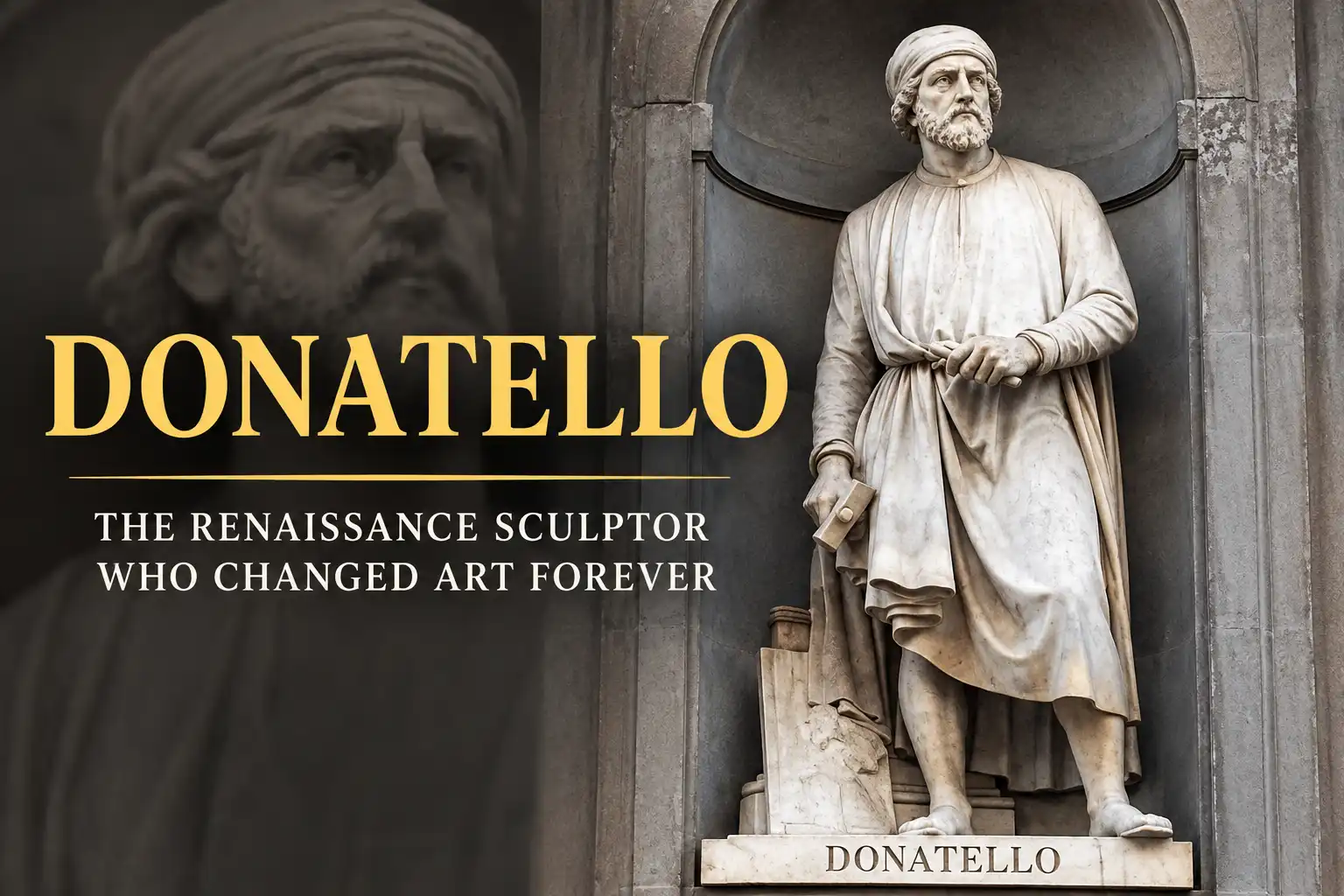
Donatello was the Italian Renaissance sculptor who taught stone and bronze to breathe. Born in Florence around 1386, he worked in marble, bronze, wood, terracotta, stucco and even glass for sixty years. His figures had a realism and expressive power that sculpture had not seen since antiquity. Few other 15th-century artists changed their field as deeply. If you want to understand early Renaissance sculpture, Donatello’s sculptures are the best place to begin.
Biography Table
| Field | Details |
|---|---|
| Full Name | Donato di Niccolò di Betto Bardi |
| Nickname | Donatello |
| Date of Birth | c. 1386 (some sources say 1387) |
| Place of Birth | Florence, Republic of Florence |
| Date of Death | 13 December 1466 |
| Age at Death | About 80 |
| Nationality | Italian (Florentine) |
| Profession | Sculptor, bronze caster, relief designer |
| Years Active | c. 1404–1466 |
| Education | Goldsmith training; assistant in Lorenzo Ghiberti’s studio |
| Genre/Field | Early Renaissance sculpture |
| Spouse/Partner | Never married |
| Children | None |
| Parents | Niccolò di Betto Bardi (wool carder) |
| Notable Works | Bronze David, St. George, Gattamelata, Penitent Magdalene, Judith and Holofernes |
| Resting Place | Basilica of San Lorenzo, Florence |
Early Life and Training in Florence
Donatello was born in Florence around 1386. His father, Niccolò di Betto Bardi, was a wool carder in the Wool Combers’ Guild. The family had modest bourgeois standing. It was a respectable household, but it had no wealth or noble connections to help the boy’s career.
According to Vasari, the young Donato grew up around the household of the Martelli family, who later became loyal patrons. He trained first with a goldsmith, and that discipline stayed with him. His later taste for gilding, fine surface treatment and precise casting comes straight from those workshop years.
Between about 1404 and 1407 he assisted in Lorenzo Ghiberti’s studio. Ghiberti had just won the famous 1401 Baptistery door competition with his Sacrifice of Isaac panel. Working on those bronze doors taught Donatello wax modelling and lost-wax casting, the skills behind his greatest bronzes.
Around the same period he travelled to Rome with his friend Filippo Brunelleschi. The two measured ruins and studied excavated classical sculpture and architecture. Locals reportedly took them for treasure seekers digging for gold. What they took home was worth more: a working knowledge of classical art.
When I trace Donatello’s early career, this Rome trip is the turning point. Before it, he was a talented craftsman in the late Gothic tradition. After it, he treated antiquity as a living source to rebuild, not a style to copy. Almost every innovation that followed has its roots there.
Donatello’s Style, Techniques and Innovations
Donatello’s style combines classical form with raw human emotion. He took the balance and anatomy of Greek and Roman sculpture and added psychological depth that the ancients rarely attempted. His saints look worried, his prophets look tired and his heroes look young and uncertain.
Rilievo Schiacciato (Squashed Relief)
Rilievo schiacciato, or “squashed relief,” is Donatello’s most original invention. He carved very shallow relief, sometimes only a few millimetres deep, and still created a convincing illusion of depth. Carving it is close to drawing in stone.
The earliest surviving example is the base of his St. George, which shows St. George and the Dragon. The figures in front are carved slightly deeper. The landscape behind them is flattened almost to nothing. The eye reads that gradual loss of depth as distance.
Many consider The Ascension with Christ Giving the Keys to St Peter (c. 1428–30) the finest surviving example. The marble surface is so delicate that the clouds and trees seem to dissolve into the stone. Later relief carvers, including Desiderio da Settignano, built their own careers on this technique.
Contrapposto and Realistic Figures
Donatello revived contrapposto, the classical pose in which weight rests on one leg and the body shifts naturally. Medieval statues usually stood stiff and frontal. His figures turn, lean and shift their balance like real people.
He also pushed realism further than his rivals. Ghiberti favoured graceful, idealized figures. Donatello carved bald heads, sunken cheeks and heavy drapery that clung to real limbs. His bell tower prophets look like men you might pass in a Florentine street.
His spiraling poses also anticipated the figura serpentinata that Michelangelo, Leonardo and Raphael would later develop. The twisting Judith is a clear early step in that direction.
Linear Perspective in Sculpture
Brunelleschi developed linear perspective as a tool for painters and architects. Donatello quickly brought it into bronze relief. His central-point perspective scenes arrange floors, arches and walls so that every line points toward one vanishing point.
The Feast of Herod, made for the Siena font, is the key example. It is among the first reliefs anywhere to use mathematical perspective to build a convincing space. The story unfolds through several rooms that recede behind the main action.
This mattered well beyond sculpture. Painters studied his reliefs to learn how to organize complex scenes. His reliefs worked almost like textbooks of the new spatial thinking in 15th-century Italy.
Materials Donatello Mastered
No other Renaissance sculptor worked in so many materials. Donatello picked each medium for its cost, setting and expressive effect. The table below summarizes his range before the details.
| Material | Key Example | Why He Used It |
|---|---|---|
| Marble and stone | St. George, Cavalcanti Annunciation | Prestige, durability, outdoor niches |
| Bronze | Bronze David, Gattamelata | Costliest medium, fine detail, casting freedom |
| Terracotta | Painted Madonna reliefs | Cheap, quick, good for models |
| Stucco | Old Sacristy tondi | Mouldable on site, easy to paint |
| Wood | Penitent Magdalene, Frari St John | Lightweight, expressive, easy to paint |
| Glass | Coronation of the Virgin window | Colour and light |
| Mixed media | Prato Pulpit, Cantoria | Glittering, layered surfaces |
Marble and Stone
Marble dominated his early Opera del Duomo commissions, including the Marble David and the bell tower prophets. He carved it with great confidence. He also carved schiacciato reliefs so thin that the surface itself does the work.
He also used pietra serena, the soft grey Florentine sandstone. It suited architectural settings and took paint and gold well. The Cavalcanti Annunciation in Santa Croce shows how well it combines sculpture with architecture.
Bronze
Bronze was the costliest material, and it gave Donatello his most famous results. Casting required wax or clay models, moulds and help from specialist foundrymen. Only rich patrons such as guilds, churches, the Medici and the Venetian state could pay for it.
He handled bronze in his own way. Instead of polishing every surface smooth, he often left chisel marks and textures visible. He also added partial gilding to catch light. His Baptistery training with Ghiberti gave him the technical base, but his finish was entirely his own.
Terracotta and Stucco
Terracotta was cheap, fast and flexible. Donatello and his workshop used fired clay for models and for painted devotional reliefs, such as the Forzori Altar of about 1415. Attribution is often difficult here, because many pieces show a shared workshop style.
Stucco, a mix of lime plaster and marble dust, could be modelled on site. That made it ideal for the eight stucco tondi of the Old Sacristy in San Lorenzo. Some Virgin and Child reliefs were also made in stucco, which allowed affordable copies for private homes.
Wood
Wood suited his late, intensely emotional religious figures. He carved the form, coated it with gesso, then painted and sometimes gilded it. The Penitent Magdalene and the St John the Baptist in the Frari in Venice, dated 1438, are the best known.
Wood let him show things marble could not carry easily. Examples include ragged hair, withered skin and thin, fragile limbs. The results feel shockingly close to the real body.
Glass and Mixed Media
Donatello even designed for glass. He supplied the design for the Coronation of the Virgin stained-glass window in the drum of the Duomo’s dome. The back of the bronze Chellini Madonna was shaped as a mould, so glass casts could be made from it.
Mixed media was one of his favourite effects. The Cantoria and the Prato Pulpit use glass-paste discs and mosaic to create a glittering background. The Piot Madonna in the Louvre combines terracotta with glass and wax roundels. The Madonna dei Cordai adds leather and pottery-shard mosaic.
Donatello’s Most Famous Sculptures
Donatello’s famous works span six decades. This timeline gives a quick overview before we look at the most important pieces.
| Work | Date | Material | Current Location |
|---|---|---|---|
| Marble David | 1408–09 | Marble | Bargello, Florence |
| St. John the Evangelist | 1408–15 | Marble | Opera del Duomo Museum |
| St. Mark | c. 1411–13 | Marble | Orsanmichele museum |
| St. George | c. 1415–17 | Marble | Bargello |
| Zuccone (Habakkuk) | 1423–25 | Marble | Opera del Duomo Museum |
| St. Louis of Toulouse | c. 1423 | Gilded bronze | Santa Croce museum |
| Bronze David | c. 1440s | Bronze | Bargello |
| Gattamelata | completed 1453 | Bronze | Piazza del Santo, Padua |
| Penitent Magdalene | c. 1453–55 | Painted wood | Opera del Duomo Museum |
| Judith and Holofernes | c. 1455–60 | Bronze | Palazzo Vecchio |
Bronze David
The Bronze David is Donatello’s most famous artwork. It is the first free-standing nude statue since antiquity and the first major unsupported standing bronze of the Renaissance. The figure is about 1.58 m tall. It shows an adolescent boy standing over Goliath’s head, holding the giant’s sword.
Its dating is still debated. Estimates range from the late 1420s to the 1460s, and most historians favour the 1440s. The statue is first recorded in 1469, standing on a column in the Palazzo Medici courtyard. That points to a Medici commission, probably from Cosimo de’ Medici.
The details are unusual. David wears only boots and a laurel-topped hat. His hair falls in curls and his face carries an enigmatic smile. A feather from Goliath’s helmet runs up the inside of his thigh. The androgyny and erotic details have made the statue controversial and much discussed ever since.
Its meaning works on several levels. Biblically, it shows a victory over evil through divine protection. Politically, Florentines saw David as a civic anti-tyranny symbol, a small republic defeating larger enemies. The relief on Goliath’s helmet, with small nude figures, adds a classical, pagan note that scholars still debate.
When you walk around it in the Bargello, you understand why it was designed to be seen from all sides. Each angle shows a different mood, from confident to dreamy to almost vulnerable. No photograph captures that shift.
Marble David
The Marble David, carved in 1408–09, is one of his first commissions. It was meant for the cathedral, but in 1416 the city moved it to the Palazzo dei Priori. There it became a civic symbol, set against a background of Florentine lilies.
Compared with the bronze version, it is less expressive and shows Ghiberti’s influence in its elegant, Gothic sway. David wears a knotted cloak and stands in a stiff pose. It shows real early carving skill, but the full Donatello personality had not arrived yet.
It is valuable because it shows where he started. Placing it beside the Bronze David shows how far he travelled in three decades.
St. George
St. George (c. 1415–17) was made for the Cuirass-makers’ guild at Orsanmichele. It is about 2 m tall. The young knight stands with his weight balanced on his feet, his shield in front of him, calm but alert. Vasari praised the life and confidence in his face.
The original marble is now in the Bargello, in the Donatello Hall. A copy stands in the reconstructed niche at Orsanmichele. The original predella relief of St. George and the Dragon, the first rilievo schiacciato, is displayed with it.
The statue introduced a new kind of figure. It is not an idealized saint floating above the world. It is a real young man about to face danger. That shift toward personality defines much of Donatello’s later work.
St. Mark
St. Mark (c. 1411–13) stands in a guild niche at Orsanmichele. The original is now in the Orsanmichele museum and a copy fills the niche. The weighty drapery and the careful shift of weight give the saint real presence.
Vasari records a well-known story. When the guild first saw the statue at ground level, they disliked its proportions. Donatello asked for time to rework it. He hid it, did nothing, and then had it raised into place. Seen from below, it suddenly looked right, and the guild approved.
Michelangelo reportedly said he had never seen a figure that looked more like a good man. That praise from the greatest sculptor of the next century says a lot.
St. John the Evangelist
St. John the Evangelist (1408–15) is a colossal seated figure, nearly two metres tall, made for a niche on the old Duomo facade. Donatello designed it to be seen from far below. The torso is elongated and the legs are shortened to look correct from street level.
When the old facade was remodeled in 1588, the statue came down. Today it sits in the Opera del Duomo Museum at eye level, so its proportions can look odd. The large hands and deep drapery still show early realism.
Many historians see its brooding presence as an ancestor of Michelangelo’s Moses. It is one of his most important early works.
Bell Tower Prophets and the Zuccone
Between 1415 and 1436, Donatello carved prophet statues for Giotto’s bell tower. They include the Beardless Prophet, the Bearded Prophet, Jeremiah (1423–26), Habakkuk (the Zuccone, 1423–25) and a Sacrifice of Isaac group made in 1421 with a collaborator.
The Zuccone, meaning “big squash” or “baldy,” is the most striking. It is bald, gaunt and wrapped in a heavy cloak. It looks less like a biblical figure and more like a real man with a harsh face. These statues read almost like medieval portraits of individual Florentines.
Vasari tells the story that Donatello would shout at the statue while carving: “Speak, damn you, speak!” The originals are now in the Opera del Duomo Museum and were restored in recent years. Many experts consider the Zuccone the finest of the group.
St. Louis of Toulouse
St. Louis of Toulouse (c. 1422–25) was Donatello’s first major bronze. It was made in gilded bronze for the Parte Guelfa niche at Orsanmichele, set in a classical frame. Its niche design was likely made with help from Michelozzo.
It was poorly received at first. Around 1460 it was moved to Santa Croce, and Verrocchio’s Incredulity of St. Thomas later took its niche. Today it stands in the Santa Croce museum, still shining with its gilded surface.
Penitent Mary Magdalene
The Penitent Magdalene (c. 1453–55) is among his most haunting works. It is carved from a white poplar trunk, painted and partly gilded, and stands about 1.85 m tall. It shows the saint after years as a desert hermit: emaciated, teeth missing, skin sun-baked, and dressed only in her long hair.
Her hands are joined in prayer and her mouth is half open. The statue is about repentance and mortality, not beauty. Her iconography blends the Magdalene with St Mary of Egypt, who also spent many years in the desert.
It originally stood in the Baptistery. It is now in the Sala della Maddalena at the Opera del Duomo Museum. Restoration after the 1966 flood revealed traces of gold in the hair, which dazzled viewers originally.
Judith and Holofernes
Judith and Holofernes (c. 1455–60) is a late bronze made for the Medici palace garden. It shows the biblical story of the widow Judith beheading the tyrant Holofernes to save her town. The twisting group is designed to be seen from many angles.
It was a Medici statement of virtue defeating tyranny, and it worked as a pendant to the David. When the Medici were driven into exile in 1495, the city turned it into an anti-Medici symbol and placed it in the Piazza della Signoria.
A copy now stands in the square. The original is protected in the Hall of Lilies (Sala dei Gigli) in the Palazzo Vecchio.
Attis-Amorino (Love-Atys)
The Attis-Amorino (c. 1435–40) is a small bronze of a cheeky putto, laughing mid-step. He wears strange breeches that expose his body and a textured belt. It was a private commission, probably for the Bartolini Salimbeni family.
Historians still argue over who he is. Theories include Attis, the shepherd of Greek myth, Eros, and a composite pagan figure. Its playful mood shows how comfortable Donatello was with classical subjects.
Major Reliefs, Pulpits and Church Projects
Donatello’s reliefs and church furnishings are sometimes overshadowed by his statues. They are just as inventive. They show him working as a storyteller and designer of complete spaces.
The Feast of Herod and Siena Works
The Feast of Herod (1423–27) is a gilded bronze relief for the baptismal font of the San Giovanni Baptistery in Siena. It shows the head of John the Baptist being presented to King Herod. The guests recoil in horror across a deep, perspective-built space.
He also made angel statuettes and virtues for the same font. Later, in 1457–59, he returned to Siena and made a bronze St John the Baptist for Siena Cathedral. The marble Madonna del Perdono relief now in the Duomo Museum also dates from this late period.
Cantoria (Singing Gallery)
The Cantoria (1433–39) was a marble singing gallery for the Duomo. It was designed as a twin to one by Luca della Robbia. Donatello filled his frieze with frenzied infants dancing against a background of glittering glass-paste discs.
The two galleries show opposite approaches. Luca’s children are calm, polished and clear up close. Donatello’s are rough and simplified, because he designed them to be seen from a distance. Ancient sarcophagi and Byzantine ivory chests inspired the frieze.
Both galleries now face each other in the Opera del Duomo Museum.
Prato Cathedral Pulpit
The Prato pulpit (1434–38), on the corner of the Prato Cathedral facade, was built with Michelozzo. It was used to display a relic of the Virgin’s girdle to crowds. Its balustrade reliefs show dancing putti against mosaic backgrounds of glass paste and smashed pottery.
The work was delayed because Donatello was in Rome in the early 1430s, around Cosimo’s exile. The contract was renewed in May 1434. It was one of the last major collaborations with Michelozzo. The originals are now in the cathedral museum and copies stand outside.
Cavalcanti Annunciation
The Cavalcanti Annunciation (around 1435) in Santa Croce is a large soft-stone relief carved in pietra serena, about 2.03 m tall. The angel kneels and Mary turns away in surprise, both set inside an ornate classical frame.
Gold highlights pick out the ornaments, hair and garment edges. It is one of the rare Donatello works still in its original setting, which makes it especially rewarding to visit.
San Lorenzo: Old Sacristy and the Pulpits
In the Old Sacristy of San Lorenzo, designed by Brunelleschi as the Medici’s private funeral chapel, Donatello made eight stucco tondi. They show the Evangelists and scenes from St John’s life, partly painted. He also made the lunettes and two bronze doors, known as the Martyrs’ door and the Apostles’ door.
Near the end of his life he worked on two bronze pulpits for the church. They show scenes from the Passion and the Resurrection. The scenes are crowded, emotional and deliberately rough. They were unfinished at his death in 1466 and completed by his assistants.
Baptistery Work: The Tomb of Antipope John XXIII
With Michelozzo, Donatello created the tomb of Antipope John XXIII in the Florence Baptistery. It was a bold choice, since the Baptistery was one of the city’s most sacred spaces. The funerary monument fits neatly between two columns.
The bronze effigy of the dead pope is attributed to Donatello. The tomb became a model for later Renaissance wall monuments. It also connects to his earlier work on Ghiberti’s north door and its small prophet heads.
Madonna Reliefs
Donatello and his workshop produced many Madonna and Child reliefs for churches and private homes. The best known are the Pazzi Madonna in Berlin (c. 1420), the marble Madonna of the Clouds in the Boston MFA, the Piot Madonna and the Madonna dei Cordai.
The Chellini Madonna is special. It is a bronze roundel that Donatello gave to his doctor, Giovanni Chellini. The back is designed as a mould, so glass copies could be cast from it. It is a rare, clever mix of art and practicality.
Reliquary Bust of San Rossore
The Reliquary Bust of San Rossore (c. 1422–25) was made for the Ognissanti church in Florence and is now in Pisa’s San Matteo National Museum. It is gilded bronze and originally held relics of the saint.
The face looks so individual that many consider it among the first true Renaissance portrait busts. It combines the preciousness of a goldsmith’s reliquary with the realism of a living portrait.
Other Works Worth Knowing
Several smaller commissions complete his catalogue:
- Marzocco – a stone lion, the heraldic emblem of Florence, now in the Bargello.
- Baptism of Christ – a baptismal font relief in Arezzo Cathedral.
- Madonna and Child relief – attributed work at Villa Guinigi in Lucca.
- Busts – the painted terracotta Niccolò da Uzzano and the Young Man with a Cameo, both with debated attribution.
- Santa Croce Crucifix – an early wooden crucifix known for its realism.
Gattamelata and the Padua Years
From 1443 to 1453, Donatello worked in Padua. It was his longest time away from Florence and one of his most productive periods. The major commission was the Gattamelata, an equestrian bronze honouring Erasmo da Narni, a mercenary commander who had served Venice.
The Gattamelata stands in the Piazza del Santo. It is often called the first large bronze equestrian statue since antiquity. The rider sits calmly, with a controlled, serious face, on a powerful horse. The model was the Roman type, especially the Marcus Aurelius in Rome.
It was a bold claim. Equestrian monuments had been reserved for emperors and rulers. Honouring a soldier this way expanded who could be commemorated in a public monument. It set the template for nobles’ monuments throughout the Renaissance.
In the same years he created the high altar of the Santo, the Basilica of Sant’Antonio. It includes the Padua Crucifix, statues of saints and bronze reliefs such as the Miracle of the Mule. The altar was later dismantled and reassembled in a different arrangement.
Some historians link the late Padua years to a personal crisis or illness. That may be one reason his later works grew so rough and intense. Whatever the cause, Padua spread Renaissance ideas across northern Italy and influenced painters such as Mantegna.
Collaboration With Michelozzo and the Rift With Brunelleschi
Donatello’s most productive partnership was with Michelozzo. Together they worked on the John XXIII tomb, the Brancacci tomb in Naples and the Prato pulpit. Michelozzo usually handled architecture and business, while Donatello focused on the figures.
His relationship with Brunelleschi was more complicated. They were friends from their youth and travelled to Rome together. A famous story involves a wooden crucifix Donatello carved. Brunelleschi mocked it, saying Donatello had put a peasant on the cross. He then carved his own to prove his point.
The real break came in the Old Sacristy. Brunelleschi felt Donatello’s reliefs and bronze doors crowded his clean architecture and fell short of his standards. The disagreement became a lifelong rift. Architecture and sculpture were competing for the same walls.
Personality, Wealth and Famous Anecdotes
Donatello was proud, generous and volatile. Vasari describes a man who cared more for freedom and his work than for money or status. Some later writers describe him as religiously indifferent, even agnostic, but that is speculation. His large body of devout work speaks for itself.
There is no reliable net worth figure for Donatello. He was financially successful and received major commissions from guilds, churches and the Medici. However, he seems to have cared little about keeping wealth.
Vasari says he kept his money in a basket hung from the ceiling of his workshop, and assistants and friends could take what they needed. The Medici gave him a farm, which he returned after a year because the worries bothered him. Cosimo reportedly gave him fine clothes, which he rarely wore.
His temper appears in the anecdotes too. When a Genoese merchant haggled over the price of a bronze bust, Donatello reportedly threw it from a window and destroyed it. His abrasive humor, stubbornness and habit of talking to his statues all fit the image of an artist consumed by his work.
Death and Legacy
Donatello died in Florence on 13 December 1466, at about 80. In old age he received a pension from the Medici. He was buried in San Lorenzo, near Cosimo the Elder, as he had wished. Fellow artists served as coffin-bearers, and he was mourned as the city’s leading sculptor.
His influence was enormous. His pupil Bertoldo di Giovanni later ran the Medici sculpture garden where young Michelangelo trained. Michelangelo’s David, though very different, would be unthinkable without Donatello’s example of heroic, individual figures. His surviving works also shaped Andrea della Robbia and many 16th-century sculptors.
He made Florence the cradle of the Renaissance in sculpture, as Brunelleschi did in architecture and Masaccio in painting. Perspective relief, the revived nude, portrait busts and public equestrian monuments all trace back to him. Studying later Renaissance sculpture, you keep running into ideas he tested first.
Where to See Donatello in Florence and Tuscany
Florence holds the largest Donatello collection in the world. Most key originals are in a few museums, so a focused two-day route covers the essentials.
| Venue | City | Key Works |
|---|---|---|
| Bargello (Donatello Hall) | Florence | Bronze David, Marble David, St. George, Marzocco, Attis-Amorino |
| Opera del Duomo Museum | Florence | Penitent Magdalene, Cantoria, St. John the Evangelist, bell tower prophets |
| Orsanmichele (first-floor museum) | Florence | Original St. Mark among the twelve Orsanmichele originals |
| San Lorenzo | Florence | Old Sacristy tondi and doors, bronze pulpits |
| Santa Croce | Florence | Cavalcanti Annunciation, St. Louis of Toulouse, wooden Crucifix |
| Palazzo Vecchio | Florence | Original Judith and Holofernes |
| Siena Baptistery and Cathedral | Siena | Feast of Herod, bronze St John |
| Cathedral museum | Prato | Pulpit relief originals |
| San Matteo National Museum | Pisa | Reliquary Bust of San Rossore |
| Piazza del Santo and Basilica | Padua | Gattamelata, high altar |
A practical tip: start at the Bargello and the Opera del Duomo on day one, because they hold the most important originals. On day two, visit San Lorenzo, Santa Croce and the Palazzo Vecchio. Check whether your Firenze Card covers each venue before you go, as coverage varies.
Remember that many outdoor works you see, including those at Orsanmichele and in the Piazza della Signoria, are copies. The originals are indoors. Once you have seen the real St. George up close, the copy in the niche will feel like an echo.
Frequently Asked Questions About Donatello
Who Is Donatello and What Are His Famous Works?
Donatello was a 15th-century Florentine sculptor and one of the most important Italian Renaissance artists. His famous works include the Bronze David, St. George, the Gattamelata, the Penitent Magdalene and Judith and Holofernes. His sculptures in bronze, marble and wood are known for accurate anatomy and strong individuality.
What Is Donatello’s Most Famous Artwork?
His most famous artwork is the Bronze David, which tells the David and Goliath story. It is surprisingly small, at just over five feet tall, yet it is considered a magnificent turning point in art history. You can see it in the Bargello in Florence.
Was Donatello Ever Married?
There is no record that Donatello ever married or had children. He devoted his life to his workshop, assistants and commissions. His personal life remains a subject of speculation among historians.
Who Were Donatello’s Students?
His best-known pupils were Bertoldo di Giovanni and Bartolomeo Bellano, who helped finish the San Lorenzo pulpits. Bertoldo later taught in the Medici sculpture garden. That link connects Donatello, indirectly, to the training of Michelangelo.
How Is Donatello’s David Different From Michelangelo’s David?
Donatello’s David is a small bronze of a slim boy shown after the victory, with Goliath’s head at his feet. Michelangelo’s David is a colossal marble of a mature, muscular youth shown before the fight. One is relaxed and triumphant, the other tense and ready.
Is the Ninja Turtle Donatello Named After the Sculptor?
Yes. The Teenage Mutant Ninja Turtles characters were named after four Renaissance artists: Leonardo, Michelangelo, Raphael and Donatello. For many people, the cartoon was their first encounter with the sculptor’s name.
What Was Donatello’s Last Work?
His last major project was the pair of bronze pulpits for San Lorenzo in Florence. They were still unfinished at his death in 1466 and were completed by his assistants. Their raw, crowded Passion scenes show his late style at its most intense.
Read About : kylie jenner age